

 Written by
 Introduction
People identified with autism spectrum disorder (ASD) experience the world differently compared to people who are not autistic. As a result, people with ASD might use the internet differently, and so might face different risks online compared to others. For example, research shows that children are 12% more likely to be bullied online if they have a special educational need like autism.
Tendencies toward compulsive behavior and social naivety also present different risks online for autistic people compared to others.
However, to say that the internet is inherently more dangerous for autistic people is an oversimplification that can result in incorrect, unhelpful, or even offensive advice. In fact, autistic people are often immensely satisfied with online experiences, and the internet delivers a lot of practical benefits for people with autism.
In this article, I want to celebrate this.
The internet exposes all of us to risk – just like nearly every big, complicated, human activity. But awareness and education can help us to mitigate risks and live safely. This guide is meant to help autistic people (and their parents, family, friends, and caregivers) learn about online risks and how to mitigate them. But it also highlights the positives to show how autistic people can use and enjoy the internet confidently and safely.
What is ASD?
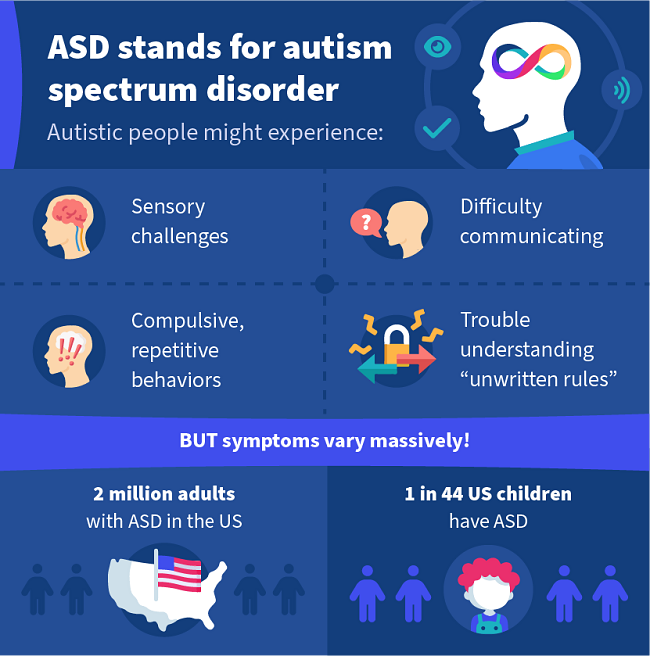
ASD is defined as a developmental disability caused by differences in the brain.
While some autistic people have a known neurological difference like a genetic condition, other causes for ASD are as yet unknown. The current consensus is that there are multiple causes of ASD that combine to alter peoples’ development.
Important Note: ASD is a name for a clinical identification and may not be accepted by everybody on the autism spectrum. Similarly, the diagnostic terms “Asperger’s syndrome” and “high functioning autism” are now considered outdated, and using them might cause offense.
Autism can lead people to communicate, interact, or learn differently, but it’s crucial to recognize that the abilities and characteristics of people on the autism spectrum vary significantly.
Some autistic people may be nonverbal, whereas others may have exceptional conversation skills. Some people need a lot of assistance to carry out their everyday lives with autism, other people on the spectrum live and work independently, and many exist in between these extremes.
Autistic people might struggle to develop and maintain relationships, communicate with others, or understand “unwritten rules” about behavior.
Sensory challenges for autistic people include increased sensitivity or intolerance to bright lights, loud or intrusive noises, or particular tastes and smells. Behaviors such as tics and obsessive compulsions are also often factors in a person’s autism.
The Internet Is Not a Monolith, and Neither Is Autism
When I’m reading and writing about internet safety I often have to remind myself: technology is not a monolith. What do I mean? I mean that a type of technology can’t be inherently good, bad, useless, helpful, dangerous, or safe.
Technology is (with some caveats) whatever its users make of it. The internet is no exception. It presents risks as well as opportunities. It can have negative and positive impacts on people’s lives, sometimes even simultaneously.
I think this is important because it means we can approach internet safety from a place of empowerment rather than a place of fear. It means we can enable ourselves and others to get the most out of the internet safely, rather than simply blocking or restricting it.
The distinction here is that while some risks are specifically related to the internet (they don’t exist anywhere else in the same way), none of them make the internet inherently risky.
There’s a related distinction to make when we’re talking about internet safety for people with ASD: some of the risks I discuss in this guide are affected by autism, but none are inherent in autism.
It’s also worth pointing out that a lot of the risks identified here are things that everybody using the internet should be looking out for. We can all be victims of phishing scams or online bullying, and all children using the internet are potentially vulnerable.
So how is using the internet different for autistic people?
Patrick Sims is a British writer who specializes in autism. He writes about how autistic people use and experience the internet differently for the UK’s National Autistic Society charity. In one piece, he wrote: (A vision of the UK’s nation of autism and society.) from the ~National Autistic Society
The positive thing about computers is that … they are potentially the greatest ever asset for autistic people. They open up a new world of potential: friends, opportunity, and employment. It is perhaps the non-autistic world who has concrete thinking and needs to accept change in terms of redefining friends and socializing.
By highlighting the positives in his article, which also discusses online bullying and radicalization, Patrick was able to explore the middle ground that balances the risks and benefits for autistic people using (neutral) internet technology.
Another way this technological neutrality plays out for autistic people is in the stimulating effects of screen time, especially when it’s interactive. Screens work like a stimulant, just like caffeine.
Autistic people who are more sensitive to this kind of stimulation might find that computer use exacerbates tics, aggression, or feelings of sensory overload. Overstimulation can make autistic people feel particularly emotional and weepy, or give them trouble sleeping. We are here to help build a community of understanding and empowerment. Please let us know how we can personally connect to start the connection today.
